
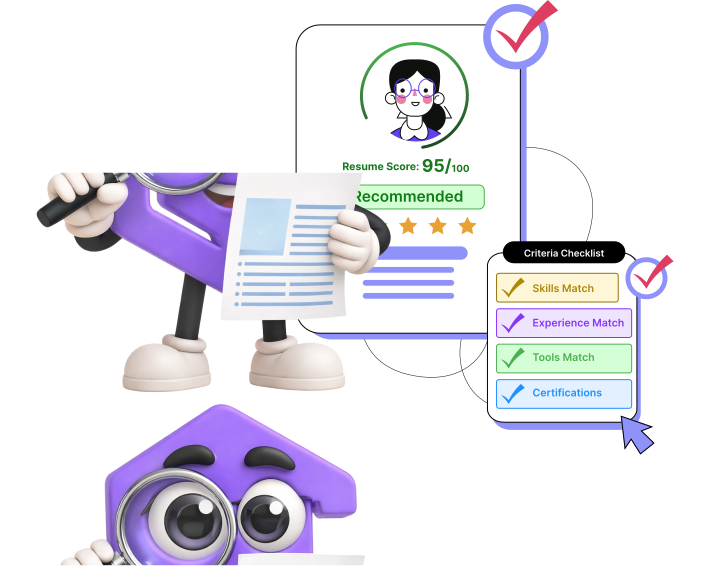
Make Resume Screening Structured, Insightful, and Decision-Ready
The stage that decides who gets interviewed shouldn't rely on guesswork or keywords.

Resume screening is critical in hiring but manual review and keyword matching often lead to inconsistent decisions and missed candidates. CoderScout Resume Scoring brings structure to this process by evaluating how well each candidate aligns with the role.
No setup required • Built for scale hiring • Designed for any role
How Resume Scoring Works
From defining role requirements to ranking candidates, CoderScout transforms resume screening into a structured and consistent evaluation process.
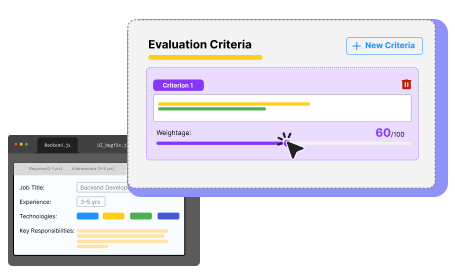
Define Job Requirements and Evaluation Criteria
Recruiters begin by defining the role requirements, including key skills, relevant experience, and other important expectations for the position. These parameters become the foundation for evaluating how well each candidate aligns with the role.
Analyze and Structure Candidate Profiles
Candidate resumes are automatically analyzed and converted into structured profiles. Important information such as skills, experience, technologies, and domain expertise is extracted and organized for evaluation
.png)
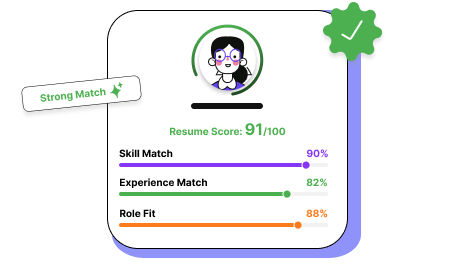
Generate Role-Based Resume Scores
Each candidate receives a structured score based on how closely their profile aligns with the job requirements. The scoring process evaluates multiple factors such as skill relevance, experience alignment, and contextual role fit.
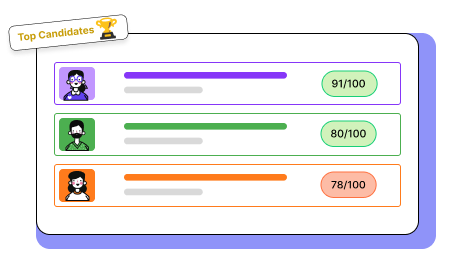
Rank Candidates by Job Role Alignment
Candidates are automatically ranked based on their overall alignment score. This allows recruiters to quickly identify the strongest candidates and focus their attention on the most relevant profiles.
Review Structured Insights Instead of Raw Resumes
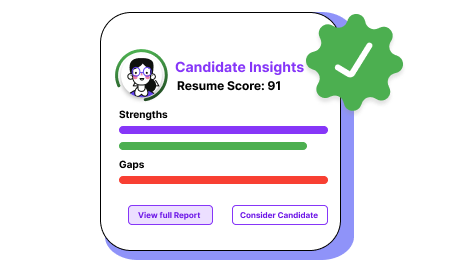
Hiring teams can review detailed candidate insights, including score breakdowns, skill matches, and role alignment signals. Instead of manually reading every resume, recruiters gain a clear and structured view of candidate fit.
What Resume Scoring Analyzes
CoderScout evaluates multiple signals in every resume to understand how closely a candidate aligns with the requirements of a specific role.
.png)
Skill Match Analysis
Compares candidate skills with the technical and functional requirements of the role. Highlights how closely the candidate’s capabilities align with the job.
.png)
Experience Role Alignment
Evaluates past roles, responsibilities, and projects mentioned in the resume. Determines whether the candidate’s experience is relevant to the position.
.png)
Role Context Fit
Analyzes technologies, domains, and responsibilities connected to the role. Measures how well the overall profile matches the job context.
.png)
Resume Signal Clarity
Transforms unstructured resume information into structured evaluation signals. Helps recruiters quickly understand candidate strengths and relevance.
Benefits of Resume Screening
75%
Faster Resume ScreeningReduce time spent on initial resume review
3x
Better Candidate DiscoveryStrong candidates surface even without perfect keywords.
95%
More Consistent HiringStandardized evaluation across all reviewers
500+
Scalable HiringHandle high-volume recruitment drives
Manual Screening vs Resume Scoring
Traditional Manual Scoring
CoderScout Resume Scoring
Make Resume Screening Faster, Smarter, and More Consistent 
Stop relying on manual resume reviews and keyword filters. Use structured resume screening to understand candidate fit, compare applicants, and shortlist the right talent with confidence.

The Growing Challenge of Resume Screening
Recruiters review large volumes of applications for every open role. Even with modern hiring tools, resume screening remains one of the most time-intensive parts of the hiring process.Read more
100+ Applications per Job
Many job postings attract 100+ applications, especially for engineering roles, remote positions, and early-career opportunities.
30 Seconds to a Few Minutes per Resume
During initial screening, recruiters often spend 30 seconds to a few minutes reviewing each resume to evaluate skills, experience, and role relevance.
Several Hours Spent on Screening
When a job receives 100+ applications, recruiters may spend multiple hours reviewing resumes before shortlisting candidates.
3-5x More Applications for Popular Roles
Highly visible job postings or campus hiring campaigns can attract three to five times more applications than typical openings.
Only a Small Percentage Move Forward
From large applicant pools, typically a small percentage of candidates progress to interviews, making early-stage evaluation critical.
How Modern Hiring Teams Evaluate Resumes
Hiring practices have evolved significantly over the years. Traditional resume screening methods often relied heavily on manual review and keyword matching.Read more
Traditional Resume Screening
- Boolean keyword matching
- Manual PDF/document reading
- Gut-feel decision making
- Inconsistent evaluation criteria
- High risk of bias
Modern Resume Screening
- Smart keyword + context analysis
- Structured resume parsing
- Checklist-based evaluation
- Some standardization
- Still time-intensive at scale
Resume Scoring with CoderScout
- Role-specific scoring algorithms
- Multi-dimensional analysis
- Automated structured scoring
- Consistent evaluation framework
- Data-driven candidate ranking
- Scalable for high-volume hiring
"Does this resume contain the right keywords?"
"How well does this candidate align with the role?"
Frequently
Asked
Questions
Recruiters and hiring teams often have questions about how resume screening works and how modern evaluation systems improve the process.
Resume screening is the process of reviewing candidate resumes to determine whether applicants meet the basic requirements of a job role. Recruiters typically evaluate skills, experience, education, and role relevance before shortlisting candidates for interviews.
Resume screening traditionally involves manually reviewing resumes or filtering them using keywords. Resume scoring evaluates candidate profiles against job requirements and assigns a structured score based on alignment with the role. This helps recruiters identify the strongest candidates more efficiently.
Resume screening can become challenging when recruiters receive 100+ applications for a single job posting. Reviewing large numbers of resumes manually requires significant time and can lead to inconsistent shortlisting decisions. Structured evaluation systems help reduce this challenge by organizing candidate data and highlighting stronger matches.
Recruiters usually evaluate several key factors when reviewing resumes: • Relevant technical or functional skills • Experience related to the role • Career progression and responsibilities • Education, certifications, or qualifications • Achievements that demonstrate impact These signals help recruiters determine whether a candidate should move to the next stage of the hiring process.
Resume scoring improves resume screening by turning resumes into structured hiring signals. Instead of relying only on keywords, candidate profiles are evaluated against job requirements and assigned an alignment score. This allows recruiters to compare candidates more objectively and identify stronger matches faster.
Yes. Resume screening plays a critical role in high-volume hiring scenarios such as campus recruitment, internship hiring, and large engineering hiring drives. Structured candidate evaluation systems help hiring teams process large applicant pools more efficiently and shortlist candidates faster.
Your next great hire starts here.
Set up in under 15 minutes. Run your first assessment today. No card. No lock-in. Just results.